


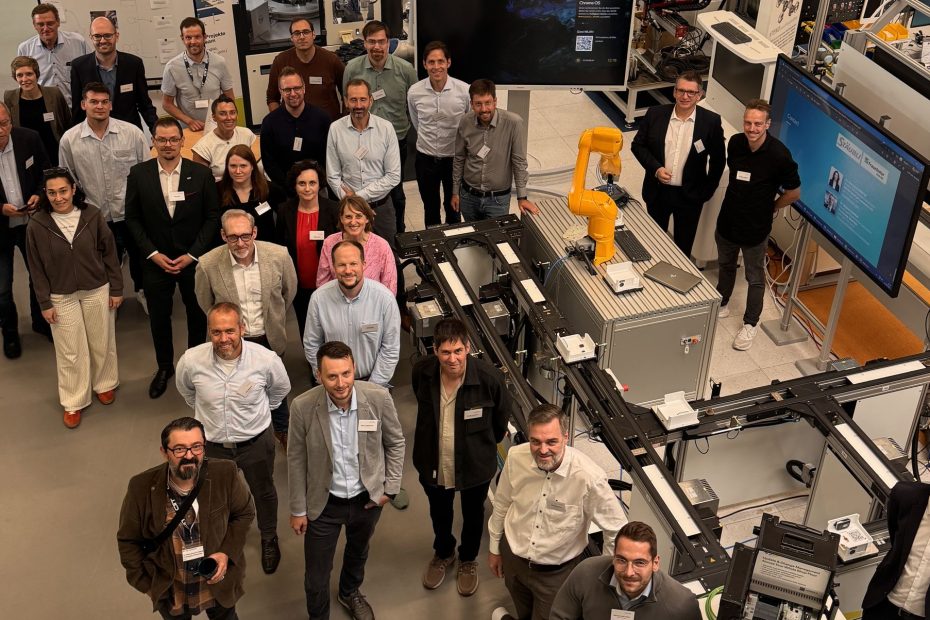
Image source: CENTRUM INDUSTRIAL IT (CIIT) e. V
How does digitalization create real added value? In Lemgo, real-world examples demonstrated how digital twins, AI, and the digital product passport are being successfully put into practice.
Digital technologies are no longer just topics of the future in the mechanical and plant engineering sectors. The crucial question today is rather: How can digital solutions be deployed in a way that generates measurable added value for companies? This was precisely the topic addressed at the joint event hosted by CIIT e.V. and ProduktionNRW on September 1, 2026, at SmartFactoryOWL in Lemgo. The focus was on practical application examples, concrete implementation strategies, and direct dialogue between industry and research.
Innovation Platform for Mechanical Engineering
To kick things off, CIIT e.V. presented the capabilities of the CIIT FactorySandbox. This real-world, multi-vendor laboratory environment serves as a testing and validation platform for current digitalization topics such as interoperability, digital twins, Asset Administration Shell (AAS), artificial intelligence, and data-driven business models. What makes it unique is that research findings and standards are translated into concrete industrial applications under realistic conditions. The FactorySandbox functions as a neutral development and testing space where companies can jointly test new technologies and evaluate their benefits for everyday production.
Digital Twins: Preventing Errors Before They Occur
The Digital Twin Factory demonstrated how production facilities can be optimized even before they go into operation, using a practical use case. With the help of digital twins, factories and facilities can be virtually planned, simulated, and tested before the first component is even installed. This allows potential errors to be identified early on, reduces risks, and prevents costly rework.
The added value of virtual commissioning was particularly evident: Instead of identifying problems on the shop floor under time pressure, they can be detected and resolved in a risk-free digital environment. Companies benefit from shorter commissioning times, lower downtime risks, less scrap, and faster time-to-market for their products. The digital twin is thus increasingly evolving from a mere planning tool into a key component for the continuous optimization of production systems throughout their entire lifecycle.
Asset Administration Shell: The Digital Twin Is Created Automatically
Another highlight was the demonstration by Fraunhofer IOSB-INA of the automated creation of Asset Administration Shells. The AAS is considered a central building block for the standardized digital twin in the Industry 4.0 environment. In practice, however, creating such data models involves significant effort for many companies.
An approach was therefore presented in which generative AI supports the automatic creation of AAS submodels. Structured digital twins are generated from existing information, which can then be verified and reused. This example illustrated how modern AI methods can help overcome existing barriers to digitalization and significantly accelerate the practical implementation of Industry 4.0 technologies.
Intelligent Data Utilization Directly from the Connector
The second use case presented by Fraunhofer IOSB-INA in collaboration with Stäubli demonstrated that valuable information does not originate solely in the machine control system. Using smart connectors as an example, the presentation demonstrated how sensor and telemetry data can be collected directly at the production line, made available in a standardized format, and used for monitoring, control, and optimization.
Temperature, pressure, acceleration, and environmental data are integrated via standardized interfaces and made available for analysis. This enables the early detection of anomalies, the prediction of maintenance needs, and the targeted optimization of processes. The solution presented clearly illustrated the potential of end-to-end data utilization throughout the entire production process and how companies can benefit from higher equipment availability, lower energy consumption, and more efficient operations management.
A Hands-On Digital Product Passport
A particular focus of the event was the Digital Product Passport. Technical presentations and demonstrations showed how product and lifecycle data can be provided and utilized in a structured manner in the future. The focus was on both regulatory requirements and new opportunities for transparency, traceability, and sustainable business models.
During the hands-on session that followed, participants were able to experience the Digital Product Passport firsthand in real production environments. Concrete application scenarios were presented both on a plastic injection molding machine and in an automated food production line. The demonstrations clearly illustrated how digital information can be provided and utilized throughout the entire product lifecycle in the future to make processes more efficient and transparent.
Exchange on Equal Footing
In addition to the technical presentations, the event offered numerous opportunities for personal exchange. At expert roundtables, participants discussed topics such as digital twins, administrative shells, automation software, security, and the Digital Product Passport with specialists from industry and research. It was precisely this combination of concrete practical examples, live demonstrations, and an open exchange of experiences that gave the event its unique character.
Conclusion
The event in Lemgo impressively demonstrated that the technological foundations for digital transformation are already in place. However, the key to success lies in the ability to translate these technologies into concrete applications and thereby achieve economic benefits. Whether digital twins, Asset Administration Shells, or Digital Product Passports: The practical examples presented illustrated how companies can already harness the potential of digitalization today to make processes more efficient, conserve resources, and tap into new opportunities for value creation. This made one thing clear: The path from technology to value creation does not begin with yet more concepts, but with the bold step toward practical implementation.
Organizer
The event was organized by ProduktionNRW. ProduktionNRW is the mechanical engineering and production technology cluster in North Rhine-Westphalia and is managed by VDMA NRW. ProduktionNRW serves as a platform to connect, inform, and promote companies, institutions, and networks with one another and along the value chain. Significant portions of the services provided by ProduktionNRW are funded by the Ministry of Economic Affairs, Industry, Climate Protection, and Energy of the State of North Rhine-Westphalia.