


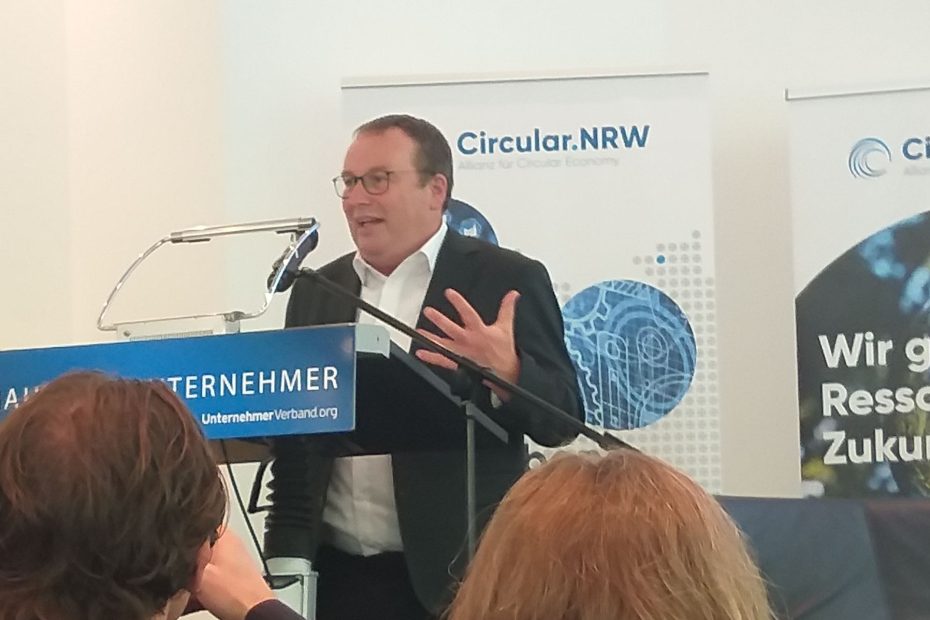
Image Source: VDMA NRW
Circular.NRW is a new alliance that brings together business, politics, and academia to visibly advance the circular economy in North Rhine-Westphalia and tap into new potential for value creation.
Closing Loops Together
Up to 125 billion euros in annual value creation through the circular economy in industry alone: This is the growth potential forecast by a recent study on the circular economy in Germany. North Rhine-Westphalia aims to establish itself as a leading location in Europe in this regard. To actively drive this transformation forward, stakeholders in North Rhine-Westphalia’s circular economy are now joining forces in the “Alliance for the Circular Economy,” or “Circular.NRW” for short. To kick things off, Minister of Economic Affairs and Climate Protection Mona Neubaur, Minister of the Environment Oliver Krischer, and Dr. Katharina Schubert, Managing Director of the State Agency for Energy and Climate Protection, are signing a declaration of principles with the alliance’s founding members.
With its recently published circular economy strategy, the state has set clear goals: In the future, economic activity in North Rhine-Westphalia is to operate more within circular loops, resources are to be used for longer, and materials are to be reused. For these goals to become a reality, cooperation among business, politics, and academia is crucial. The new umbrella brand “Circular.NRW”—initiated by the Ministries of the Environment and Economic Affairs and housed at NRW.Energy4Climate—now provides the appropriate framework for this. It enables stakeholders in North Rhine-Westphalia’s circular economy to create synergies and increase the visibility of their activities. At today’s symposium, “The Circular Economy as an Economic Factor: Strategies for Implementation in North Rhine-Westphalia,” held in Duisburg, key players in the circular economy are coming together for the first time under the umbrella of Circular.NRW. With the signing of the alliance declaration, many dedicated stakeholders are coming together to form a visible, unified movement.
Background
A strong circular economy is crucial for a competitive and resilient North Rhine-Westphalia. Circular business models strengthen competitiveness, reduce dependence on imports of critical raw materials, create future-proof jobs, and enable new value creation: A study published in May 2026 by the Boston Consulting Group on behalf of the Federation of German Industries forecasts a realistic growth potential for annual circular value creation in German industry alone—from the current level of around 60 billion euros to as much as 125 billion euros. The study examined the sectors of mobility, mechanical engineering, construction, energy, and textiles, which account for approximately 60 percent of industrial value creation in Germany.