


Europe’s competitiveness was the focus of the Lithuanian-German Economic Forum in Düsseldorf. VDMA and LINPRA formalize their closer cooperation.
On November 4, 2026, on the occasion of Lithuanian President Gitanas Nausėda’s visit to Düsseldorf, representatives from politics and industry gathered at the Lithuanian-German Economic Forum, which was co-hosted by the VDMA. The discussion centered on how Europe’s competitiveness can be improved through stronger cooperation within the European Union.
In a panel discussion moderated by Dr. David Blass, Managing Director of VDMA NRW, and titled “Strengthening European Industry: Competitiveness and Cross-Border Cooperation,” Gintautas Bartkus, Vidmantas Janulevičius, Ralf Schlindwein, and VDMA Vice President Verena Thies discussed the prerequisites for a competitive European industrial sector.
It became clear that Europe possesses considerable industrial and technological potential. To better harness this potential, however, existing barriers in the European Single Market must be systematically removed, and the Capital Markets Union must be advanced. For the export-oriented machinery and plant engineering sector in particular, a functioning single market creates additional sales and procurement opportunities, as well as new prospects for cross-border and more resilient value chains. Europe can only strengthen its industrial competitiveness by working together.
VDMA and LINPRA Agree to Closer Cooperation
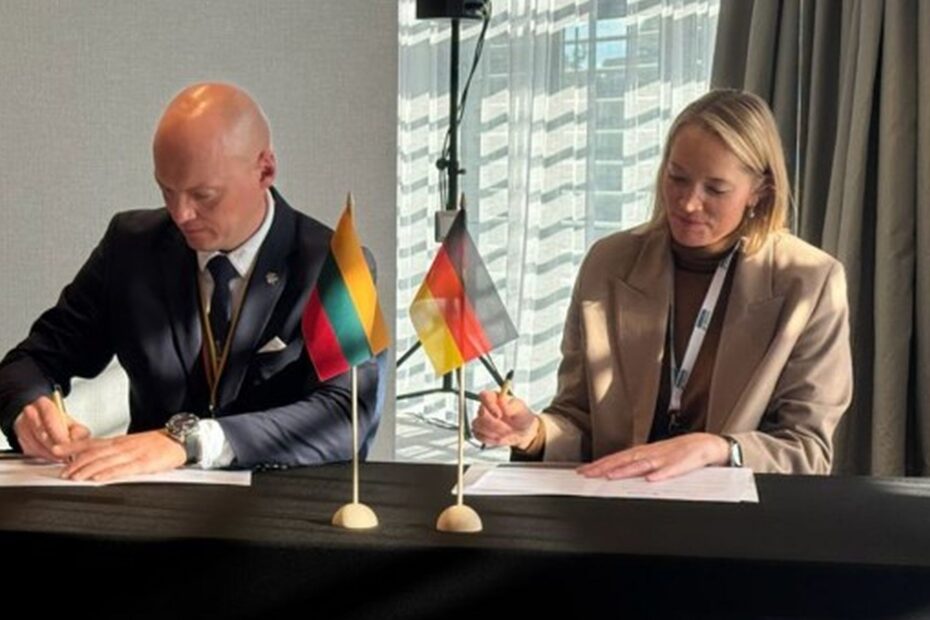
One concrete outcome of the Economic Forum was the signing of a Memorandum of Understanding between VDMA and LINPRA, the Engineering and Technology Industries Association of Lithuania. Tomas Prūsas, President of LINPRA, and VDMA Vice President Verena Thies agreed to further expand cooperation between the two associations and, in particular, to intensify direct exchanges between their member companies.
The focus is on future-oriented fields such as automation and robotics, digitalization and artificial intelligence, as well as advanced production and manufacturing technologies. The interplay of these technologies, in particular, offers great opportunities to tap into the potential of Industrial AI for the European machinery and plant engineering sector.
For the VDMA, this cooperation also serves as an example of how European industrial policy can be brought to life in concrete terms: through closer collaboration among companies, joint technological initiatives, and cross-border industrial networks.
After all, Europe’s industrial strength does not stem from isolation, but rather from a robust single market, technological cooperation, and strong partnerships between its industrial regions.