


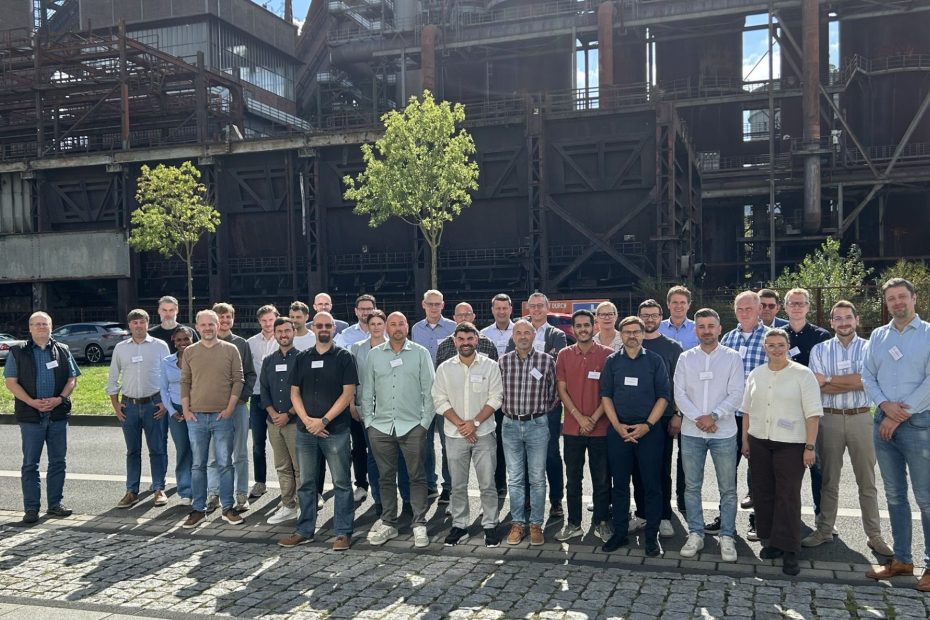
Practical, interactive, and immediately applicable: The workshop organized by KI.NRW provided tools to systematically tap into AI potential within companies.
How can companies successfully begin using artificial intelligence in their operations? On September 10, 2026, participants from the mechanical and plant engineering sector in North Rhine-Westphalia addressed this question. Together with KI.NRW, ProduktionNRW organized a hands-on workshop. The goal of the event was to help companies identify specific AI use cases and develop initial steps toward implementation.
The KI.NRW experts Michael Kirsch, Fabio Griehl, and Luca Schouren introduced participants to the world of artificial intelligence. It became clear that AI is no longer just a topic for the future—it is already present today in many areas of everyday life and industrial practice. At the same time, the workshop highlighted just how diverse the potential applications along industrial value chains have become.
From AI Fundamentals to Industrial Use Cases
First, the speakers provided a clear, basic understanding of modern AI technologies. In addition to contextualizing current developments, they explained key differences between traditional rule-based systems, foundational AI models, and specialized AI solutions. Furthermore, participants received an overview of analytical, generative, and agent-based AI applications, as well as their relevance to industrial processes.
Using numerous practical examples from North Rhine-Westphalia, it became clear how companies can already benefit from AI today. Among other things, the presentation covered application areas such as predictive maintenance of machinery, the optimization of production and logistics processes, automated quality control using image processing, the use of AI in engineering, and modern knowledge and assistance systems for employees.
Own Challenges as a Starting Point
However, the event did not focus on the technology itself, but rather on its concrete operational application. Under the guidance of KI.NRW, participants worked according to the proven KI.Scouting approach. The starting point was the identification of challenges, bottlenecks, and routine tasks within their own companies. The key message: It is particularly helpful to derive AI use cases from specific problems and opportunities for improvement in everyday work.
In a structured brainstorming session, the participants developed numerous potential use cases along their own value chains. In doing so, they considered existing data sources as well as process weaknesses and new technological possibilities. This was followed by the selection of particularly relevant use cases, which were then further developed by the company teams.
Developing and Evaluating AI Solutions
Based on the selected use cases, the teams developed initial solution outlines. Using a structured scouting card, they described challenges, possible AI approaches, expected added value, and the necessary prerequisites for implementation. The focus was on questions regarding benefits, cost-effectiveness, data availability, and organizational feasibility.
The subsequent plenary discussion proved particularly valuable. Selected solution approaches were presented, discussed, and jointly evaluated. The methodical comparison of potential benefits and feasibility helped participants set realistic priorities for their next steps and flesh out initial implementation ideas.
Success Factors for Implementation
In addition to identifying use cases, the speakers also examined the organizational and regulatory frameworks for successful AI projects. Topics such as data quality, change management, governance, data protection, and the requirements of the European AI Regulation played an important role in this context. It also became clear that building AI competencies within the workforce is a key prerequisite for the sustainable use of such technologies.
Successfully Putting AI into Practice
The workshop impressively demonstrated that getting started with artificial intelligence is not a matter of company size or extensive prior knowledge. Rather, what matters most is taking a structured look at one’s own processes and being willing to systematically tackle specific challenges. Through practical methods, knowledge presented in an accessible way, and open discussion among participants, attendees gained valuable insights for their individual AI journeys.
Further Information
- Links to further information from KI.NRW on KI.Scouting and AI.Shadowing are provided below.
- Information on funding opportunities for AI projects is available from NRW.BANK.
- The AI.Map offers numerous practical and user examples from North Rhine-Westphalia.
- The KI.KompetenzNavi provides an overview of free training and continuing education opportunities related to artificial intelligence.