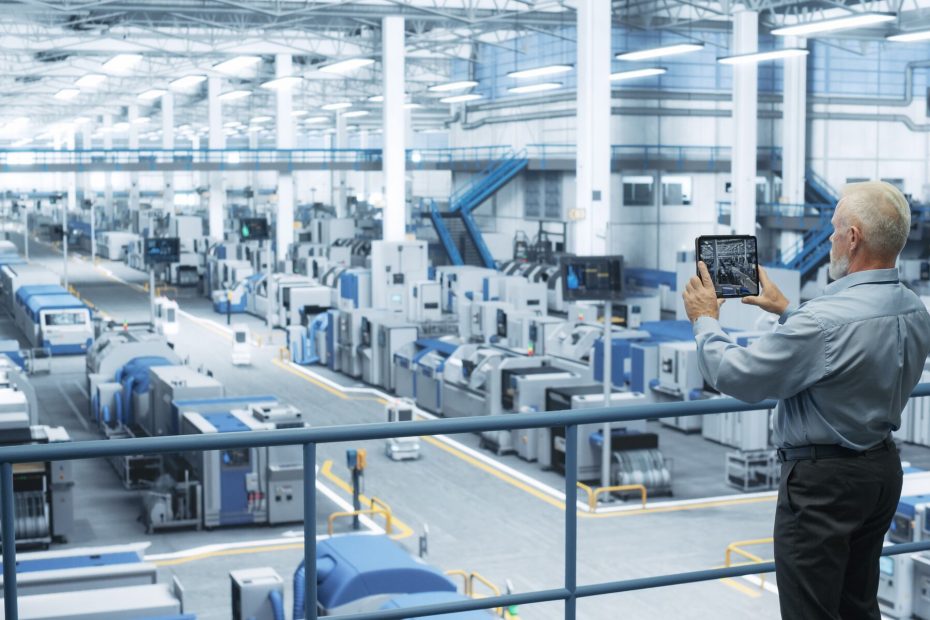
How AI is advancing mechanical engineering: Specific examples show how intelligent data analysis increases quality, speeds up processes and opens up new efficiency potential.
Artificial intelligence (AI) is increasingly finding its way into industrial applications, including in mechanical and plant engineering. However, although there is great interest, many companies have not yet fully exploited the possibilities.
To give North Rhine-Westphalia’s mechanical and plant engineering industry an overview of current developments and practical applications, ProduktionNRW and VDMA Software and Digitalization organized a virtual information event on 9 February 2026. Practical application examples and product-neutral technology presentations showed how to successfully get started with AI and machine learning (ML) and anchor them in the company in the long term.
AI activities in the VDMA
Carsten Rückriegel, consultant at VDMA Software and Digitalization, gave an overview of current surveys, studies and association activities relating to the topic of AI.
One key finding: AI is becoming increasingly important worldwide and is developing into the key technology of the coming years. For example, 67% of respondents to the global Bosch study rate AI as the most important technology of the future. At the same time, the study shows that Germany still has potential to tap into when it comes to AI training compared to countries such as China and India – an opportunity to further develop its own strengths. On the other hand, there are numerous successful practical examples from the mechanical engineering sector that demonstrate great potential – from efficiency increases and better forecasts in critical processes to the development of new services and business models.
Weidmüller experience report: Industrial AI in practice
Dr. Carlos Paiz Gatica, Product Owner Industrial Analytics at Weidmüller Interface GmbH & Co. KG, showed how Industrial AI solutions can be implemented in industrial environments in a scalable manner. Among other things, the focus was on
- specific use cases such as predictive quality, machine monitoring and process optimization,
- an end-to-end workflow from data acquisition and model validation through to the productive deployment of ML models,
- the Industrial ModelBuilder and ResMa as tools that domain experts can use to develop their own anomaly and prediction models without in-depth data science expertise,
- approaches for the direct integration of ML models in automation environments, for example via edgeML.
- It became clear: The key to scalable AI solutions lies in the interplay of domain knowledge, AI technologies and no-code approaches.
Experience report point8: AI assistance systems and data-driven services
In the subsequent presentation, Dr. Julian von der Ecken, Partner & Project Management at Point 8 GmbH, presented an example of implementation at Windmöller & Hölscher SE & Co KG. Three use cases were used to illustrate the added value of AI-based solutions:
- AI assistance system for monitoring complex production processes:
In demanding production environments, such as film extrusion, AI models help to ensure stable production conditions, reduce waste and relieve operators in a targeted manner. The system automatically recognizes good production, identifies products using fuzzy logic and continuously monitors relevant process parameters. - RUBY AI:
An innovative solution enables machine data to be queried in natural language. Based on generative AI, users can carry out analyses, ask questions and receive contextualized interpretations without specialist knowledge – an important step towards intuitive human-machine interaction. - Data-driven performance consulting based on OEE analyses:
Standardized analyses of production data and comparison with benchmarks from the technical centre, simulation or best practice experience provide data-based support for after-sales service. This allows optimization potential to be identified more quickly, customer loyalty to be strengthened and additional sales or retrofit approaches to be developed.
Standardized analyses of production data and comparison with benchmarks from the technical centre, simulation or best practice experience provide data-based support for after-sales service. This allows optimization potential to be identified more quickly, customer loyalty to be strengthened and additional sales and retrofit approaches to be developed.
The event made it impressively clear that the mechanical and plant engineering industry is at a turning point: AI is no longer a topic for the future, but is already delivering real benefits today – from efficiency increases and new services to sustainable business models.
Organizer
The event was organized by ProduktionNRW. ProduktionNRW is the cluster for mechanical engineering and production technology in North Rhine-Westphalia and is organized by VDMA NRW. ProduktionNRW sees itself as a platform for networking, informing and marketing companies, institutions and networks with each other and along the value chain. Significant parts of the services provided by ProduktionNRW are funded by the Ministry of Economic Affairs, Industry, Climate Protection and Energy of the State of North Rhine-Westphalia.