


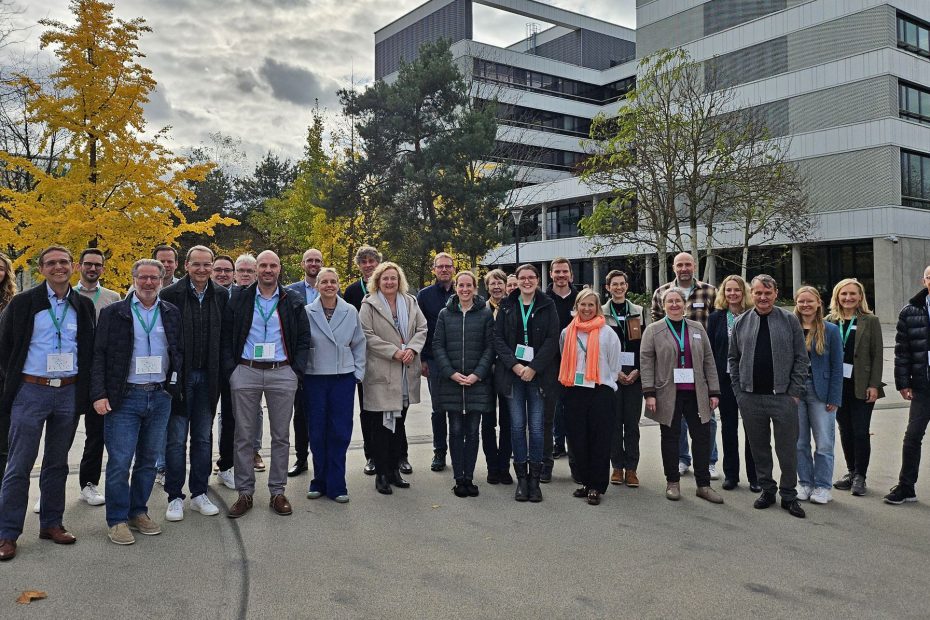
Circular economy as an opportunity: CIRCO workshops support companies in becoming more resilient through circular product design and new business models.
Switching to circular product design and circular business models offers companies the opportunity to make products and processes more resilient, even in times of crisis. The circular economy – known internationally as the circular economy – aims to maximize the value of raw materials and products by extending their useful life, keeping materials in circulation and using resources more efficiently. Companies benefit from reduced dependence on volatile raw materials markets, greater resource efficiency and long-term cost benefits. The circular economy therefore makes a decisive contribution to securing competitiveness and stable value creation processes.
To make it easier for companies to get started, ProduktionNRW and Effizienz-Agentur NRW (efa) held the CIRCO workshop series exclusively for companies in the North Rhine-Westphalian mechanical and plant engineering sector from October 30 to December 4, 2025. The two face-to-face workshops took place at WILO SE, a pioneer of the circular economy in NRW.
Added value through circular design
The CIRCO method, developed in the Netherlands in 2015, supports companies in three successive phases – from the analysis of their own value chain to the development of a roadmap for the implementation of circular projects in their own company. First, the participants take a critical look at their existing value chain and identify circular starting points. Building on this, they develop concrete ideas for new business models, product (re)designs or supplementary services. In the final phase, these approaches are translated into an action plan and timetable and recorded in a circular business model canvas.
Importantly, the CIRCO track forms the basis for the strategic further development of your own business model. The concrete implementation in the company takes place afterwards – based on the concepts developed and prioritized fields of action.
The companies participating in the CIRCO Track for mechanical and plant engineering dealt with topics such as return systems for resources, products or individual components, the recycling of packaging and strategies for extending product lifetimes. In doing so, they addressed key levers for reducing dependencies on raw materials, stabilizing costs and making value creation more sustainable.
As Germany’s first CIRCO hub, the Effizienz-Agentur NRW offers a practical introduction to circular product design with this format. Expert input, digital tools and an intensive exchange between the companies ensure that theory becomes concrete solutions.
The companies were accompanied by three experienced CIRCO trainers: Dr. Nicole Freiberger (Project Coordination & Consulting Rhineland), Ines Haydn (Deputy Head of Development & Cooperations) and Nadine Tiedemann (Head of the CIRCO Hub), who showed the participants how ecological responsibility and economic resilience can be successfully combined. The result: well-founded concepts that support companies in aligning their business models for the future and strategically exploiting the opportunities of the circular economy.