


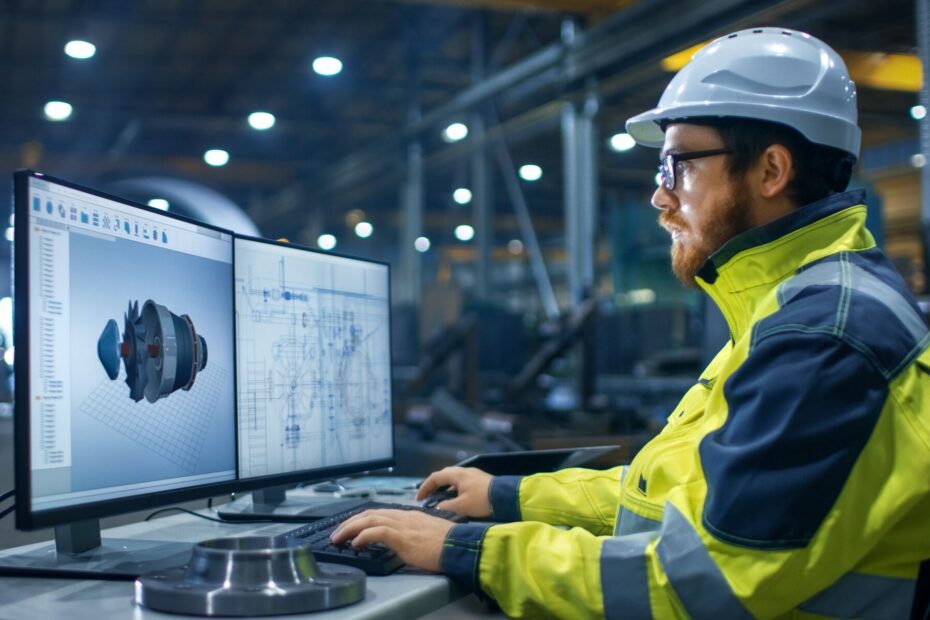
Mastering Variants, Reducing Complexity: The event demonstrated how holistic variant management creates efficiency and ensures value creation throughout the product lifecycle.
Customized products, short innovation cycles, and increasing demands for customization are leading to ever-greater variant diversity in the machinery and plant engineering sector. While this creates competitive advantages, it also increases complexity in development, sales, manufacturing, and service. Professional variant management helps to effectively manage this complexity and efficiently meet customer requirements. Against this backdrop, ProduktionNRW hosted a virtual information session on the topic of variant management on October 27, 2026.
Variant Management as a Change Management Project
Thomas Riegler, a consultant at VDMA Software and Digitalization, characterized variant management as a holistic task. He emphasized that it is crucial not only to manage variants within individual departments but also to consider their impact across the entire value chain.
Development and design, marketing and sales, procurement, production, service, and controlling are all equally affected.
As a result, successful variant management also becomes a change management project. New processes and systems alone are not enough. It is crucial to involve the affected employees early on and to create the necessary organizational conditions. Success factors include the involvement of key users and IT, sufficient resources, clear goals, and uniform rules for filing, naming, and data maintenance.
Managing Variants Throughout the Entire Lifecycle
Holger Senn, Director and Industry Advisor for CLM at Configit GmbH, demonstrated how companies can use technology to manage increasing product complexity. Variants arise from a multitude of decisions and dependencies, causing the workload in development, manufacturing, documentation, and service to grow rapidly.
Instead of managing individual variants, Configuration Lifecycle Management relies on end-to-end control of variability throughout the entire product lifecycle. A consistent decision-making framework links product and configuration knowledge from development through service and can simultaneously create a robust foundation for the use of artificial intelligence.
Variant Management from an After-Sales Perspective
Mijo Tadic, Team Leader of Technical Product Coordination at 2W Technische Informations GmbH, demonstrated the long-term effects that variant diversity has on service and spare parts supply. A high number of variants increases inventory costs and ties up capital, while also complicating data maintenance, change management, and long-term supply.
Using an example drive portfolio, he illustrated how 14 production variants can be reduced to two replacement variants with supplementary add-on components. By consolidating functional scopes and using multi-compatible base components, spare parts supply can be simplified without limiting the required functionality of the different variants. This reduces costs and complexity while ensuring long-term supply.
Conclusion
The event made it clear: variant diversity enables customized customer solutions but must not lead to unnecessary internal complexity. Successful variant management therefore combines organizational and change management, a consistent digital data and decision-making foundation, and a view of the entire product lifecycle. In this way, companies can manage diversity, simplify processes, and secure their value creation in the long term.
Organizer
The event was organized by ProduktionNRW in cooperation with VDMA Software and Digitalization. ProduktionNRW is the cluster for mechanical engineering and production technology in North Rhine-Westphalia and is operated by VDMA NRW. ProduktionNRW serves as a platform to connect, inform, and promote companies, institutions, and networks with one another and along the value chain. Significant portions of the services provided by ProduktionNRW are funded by the Ministry of Economic Affairs, Industry, Climate Protection, and Energy of the State of North Rhine-Westphalia.